Curriculum Vitae
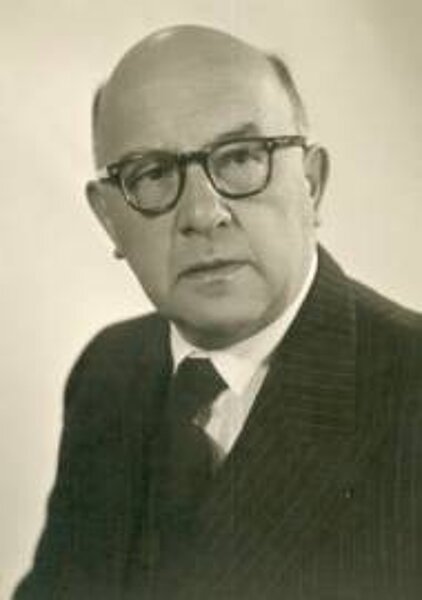
Otto Theodor Volk was born on 13 July 1892 in Neuhausen auf den Fildern, southeast of Stuttgart. From 1903 to 1906, he attended Latin school in Rottenburg am Neckar, then from 1906 to 1910, he attended grammar school in Ehingen an der Donau, graduating in 1910 with his Abitur (A-levels).
From 1910 to 1914, he studied Catholic theology, philosophy and mathematics at the University of Tübingen as a member of the Wilhelmsstift. In 1914, he passed the state examination in theology and was ordained in 1915.
However, his interest in mathematics was so strong that he decided to continue studying mathematics at the University of Tübingen and the Technical University of Munich. In 1917, he completed his studies with the first civil service examination for higher education and then went on to teach at secondary schools in Schwäbisch Gmünd and Feuerbach, where he passed the second civil service examination for higher education in 1918.
At the same time, he worked on his dissertation, which had been suggested by Liebmann. In 1918, he received his doctorate in engineering from the Technical University of Munich. A year later, he accepted an invitation from Lindemann to join the University of Munich and became an assistant to Lindemann, Pringsheim and Voss. In 1920, he received his doctorate in philosophy from the University of Munich with a thesis supervised by Lindemann. He also qualified as a professor there in 1922.
In the same year, he accepted a position at the newly founded University of Kaunas in Lithuania. From 1923 to 1930, he was a full professor and director of the Institute of Mathematics and Astronomy in Kaunas, which he first had to establish.
Initially, he was allowed to hold lectures, exercises and seminars in German; after about three years, he was already giving a main lecture in Lithuanian. His first works appeared in Lithuanian in 1924, initially consisting of biographies of important mathematicians. He then began to write mathematics textbooks in Lithuanian, often becoming the creator of mathematical terms in the Lithuanian language under the guidance of his students.
Towards the end of the 1920s, political conditions in Lithuania became difficult under Soviet pressure. It was therefore a relief for Otto Volk when he received an offer to become an associate professor in Würzburg in 1930. In 1932, he became a full professor and in 1935 he was appointed to the vacant chair as successor to Eduard von Weber. After Georg Rost's retirement, he also took over responsibility for astronomy.
From 1937 onwards, he was director of the Mathematics Seminar and head of the Astronomical Institute and Observatory at the University of Würzburg. This enabled him to pursue his long-standing interest in astronomy in the years that followed and to carry out systematic astronomical observations of minor planets and comets. Parallel to his observations, he also dealt with questions of celestial mechanics.
Although he, like most of his colleagues, was removed from office by the military government in 1945, he immediately set to work clearing up the university. However, his intensive efforts to be reinstated were delayed due to various obstacles. From 1947 to 1948, he was initially an employee and deputy director of the Mathematical Research Institute in Oberwolfach. Finally, in 1949, he was reappointed as a full professor at the University of Würzburg and simultaneously retired for health reasons. He then took on teaching assignments at the Ohm Polytechnic in Nuremberg and at the University of Cologne. In 1959, he reached retirement age and was thus granted the right to offer lectures in Würzburg again. He made active use of this opportunity, lecturing on topics from celestial mechanics and the history of mathematics until the summer semester of 1988.
The period following his retirement was filled with a wide range of activities, which he pursued with great energy, enthusiasm and perseverance. In 1969, he received an offer to move to Izmir (Turkey), which he declined. In his final years, his declining eyesight made him increasingly dependent on assistants. However, he always had a group of students around him who appreciated him and were happy to lend a hand.
Four periods can be identified in his scientific work. During his time in Munich, he focused on analysis; his work in Kaunas was then devoted to differential geometry. During his time in Würzburg, his interest was initially in astronomy and, after the war, in the history of mathematics, celestial mechanics and astronomy. His works were compiled in 1990 by the Faculty of Mathematics in a small edition as Collected Treatises. In 1995, his Lithuanian essays were published in German under the title Mathematics and Knowledge.
Until the end of his life, he took an active interest in the affairs of the faculty. The crowning achievement was the establishment of the Otto Volk Foundation for the Faculty of Mathematics in 1983, for which he was inspired by Prym's generous endowments. The proceeds from the foundation are to be used to promote mathematics, celestial mechanics and the history of mathematics and astronomy. He also appointed his foundation as his sole heir.
In recognition of his services, he was awarded the Federal Cross of Merit on Ribbon in 1987. In accordance with his wishes, a memorial room in the Mathematical Institute has been furnished with furniture from his estate and serves as an archive and guest room. A commemorative plaque on the tower of the Neubaukirche also bears witness to his work, commemorating the university observatory and the Würzburg astronomers who carried out their observations there until 1945.
After several falls in his home, he became dependent on care at the end of 1988. He was lovingly cared for and passed away on 21 March 1989.