Plenary Talk
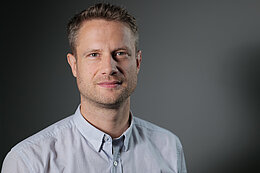
Christian Anderson - Malmö University
Christian H. Anderson is a Lecturer in Mathematics Education at Malmö University, Sweden, within the Department of Natural Science, Mathematics and Society. His research focuses on the intersection of mathematics education and the rapidly evolving digital landscape. Specifically, Christian investigates the ethical, critical, and practical implications of AI and machine learning in the classroom, alongside exploring critical literacy regarding Big Data. Specifically, he explores how these new digital phenomena align or contradict norms and traditions in mathematics education. In addition, his work involves developing professional development initiatives that enable upper secondary school mathematics teachers to gain credentials for teaching ethical and critical perspectives on AI.
As Artificial Intelligence (AI) and machine learning increasingly dictate socio-political structures, the demand for a digitally literate citizenry has never been more urgent. Yet, public and educational discourses often treat AI as an ambiguous "black box," masking the reality that AI systems are fundamentally mathematical architectures operating on large scales of training data. This keynote addresses the critical necessity-and systemic challenges-of integrating critical AI literacy into upper secondary mathematics education.
Drawing from the findings of my doctoral research, this talk explores the inherent tension between the emergent need for critical AI literacy and the entrenched traditions of mathematics education. While classroom-based action research demonstrates that teaching ethical, data-driven mathematical models is highly possible, widespread implementation faces friction. Because traditional mathematics education has long fostered the perception that mathematics is an objective, neutral tool, that is a solution to problems but never the cause of them.
By analyzing student discourses-ranging from those who successfully weaponize mathematical understanding to critique discriminatory algorithms, to those who view mathematical systems as unchallengeable-this presentation maps out how classic classroom expectations act as an obstacle to modern literacy. Finally, we will discuss a structural path forward. By shifting the pedagogical focus from rote calculation to critical mathematical modeling, we can empower educators to break traditional bounds and prepare students for an AI-driven society.

Zehavit Kohen - Technion - Israel Institute of Technology
Zehavit Kohen is an Associate Professor at the Faculty of Education in Science and Technology at the Technion – Israel Institute of Technology and head of the Mathematics Teacher Education & Development (MtED) Lab. Her research expertise lies in mathematical modelling and its integration into STEM education, with a particular focus on authentic technological, scientific, and engineering applications. She investigates how modelling can support meaningful mathematics learning and how teachers can effectively design, implement, and facilitate modelling experiences across educational settings. Professor Kohen has led numerous large-scale research and development initiatives in mathematical modelling, including the nationwide i-MAT (Integrated Math & Technology) program, which has been incorporated into Israel’s national middle-school mathematics curriculum. Her work has contributed significantly to advancing modelling-based approaches to mathematics teaching, teacher education, and interdisciplinary STEM learning, particularly through the conceptualization and implementation of Structured Mathematical Modelling in authentic STEM contexts.
Contextualized tasks play a central role in connecting mathematics with meaningful scientific, technological, and engineering problems. Yet, sharing an authentic STEM context does not necessarily mean that tasks cultivate the same form of
mathematical engagement. This plenary talk examines the distinctions and productive overlaps among word problems, mathematical literacy tasks, and mathematical modelling tasks, focusing on how each allocates mathematical agency and epistemic
responsibility to learners. Drawing on a multidimensional conceptual framework and an empirical study involving experts and practicing teachers, the talk explores how these task forms are classified, how theoretical exposure shapes such
classifications, and how their curricular and STEM contributions are perceived. The discussion extends this continuum to engineering design, where mathematical models become tools for developing, testing, and refining solutions under authentic
technical, environmental, and social constraints. This perspective offers a design resource for purposefully advancing learners’ mathematical agency in STEM education.