Oberseminar Deformationsquantisierung und Geometrie: Francesco Cattafi (JMU)
Sub-Riemannian structures and non-transitive Cartan geometries via Lie groupoids
| Date: | 04/17/2026, 2:00 PM - 3:00 PM |
| Category: | event |
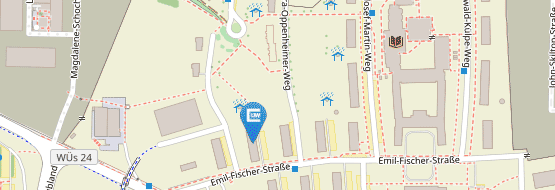
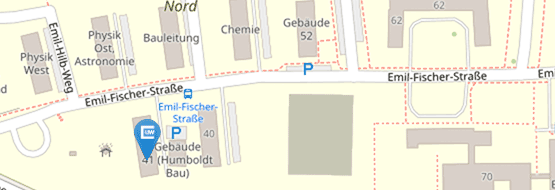
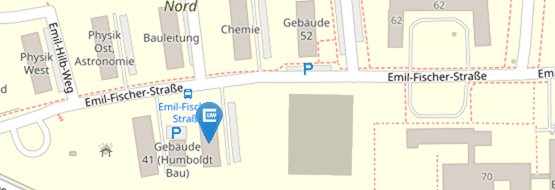
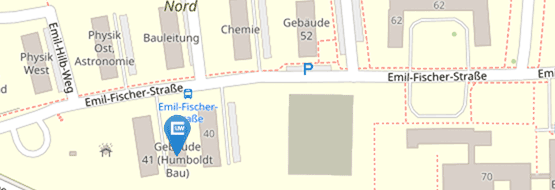
| Location: | Hubland Nord, Geb. 31, 31.00.018 |
| Speaker: | Francesco Cattafi (JMU) |
Abstract:
Connections on principal bundles are an ubiquitous tool in differential geometry and mathematical physics. The standard approach to connections, due to Ehresmann, describes them in terms of horizontal subbundles or of Lie algebra-valued differential forms. However, a different (although closely related) approach to connections originated from the pioneering works of Felix Klein and Élie Cartan. Indeed, in his famous Erlangen program, Klein introduced the idea that each (possibly non-Euclidean) “geometry” should be described by groups of transformations. Cartan took these geometries as "standard model" and used them to give rise to his "espaces généralisés". Such spaces become “locally Klein” under a suitable flatness condition, in the same way that a Riemannian manifold whose curvature vanishes is locally the flat Euclidean model.
In this talk I will review the modern formulation of Cartan geometries (principal bundles endowed with Cartan connections) and their role in obtaining invariants of geometric structures. I will then discuss how Lie groupoids provide us with a clearer framework to understand these topics and to tackle new problems. In particular, I will focus on how to associate a suitable non-transitive version of a Cartan connection (i.e. a "Cartan groupoid") to sub-Riemannian manifolds of corank 1 with non-necessarily constant "sub-Riemannian symbols". This will require considering the (non-transitive) groupoid of sub-Riemannian symmetries and investigate its properties in relation with the variation of the sub-Riemannian symbols. Last, I will discuss how to upgrade such (Lie) groupoid to a Cartan groupoid, by means of a tautological form and a multiplicative Ehresmann connection.
This is joint work with Ivan Beschastnyi and João Nuno Mestre.
Back