Matthias Schötz, Dr.
Postdoc
Dr. Matthias Schötz
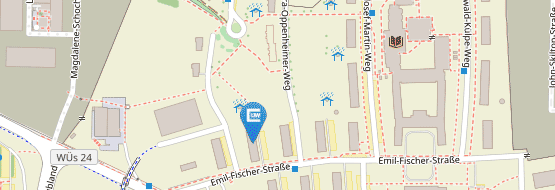
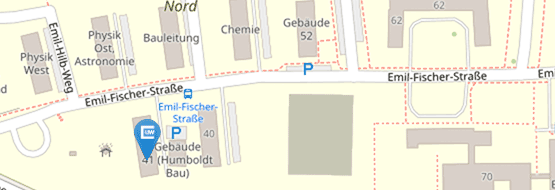
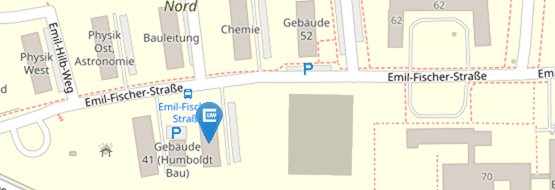
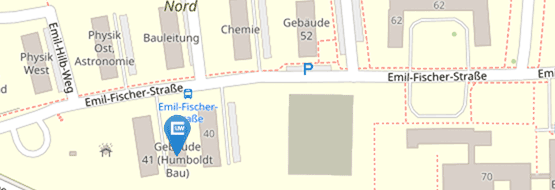
Emil-Fischer-Straße 31

*-Algebras and noncommutative real-algebraic geometry:
I investigate the structure of *-algebras of in general unbounded operators, particularly with regard to their applications in modeling observable algebras in quantum physics. Noncommutative real algebraic geometry provides the appropriate methods for this: While classical, “commutative” real algebraic geometry deals with ordered commutative algebras and their representations as algebras of functions (e.g., as polynomial functions on an algebraic set), noncommutative real algebraic geometry broadens the perspective to ordered *-algebras and their representations by operators on Hilbert spaces (e.g., as products of the position and momentum operators known from quantum mechanics). This view of operator algebras is also a generalization of the theory of C*-algebras, which represent the special case of complete bounded ordered *-algebras with closed positive elements. Specifically, I am currently working on two main problems:
-
How can results from classical real algebraic geometry (e.g., Positivstellensätze and Nullstellensätze) be transferred from the commutative to the noncommutative case (e.g., to universal enveloping algebras of Lie algebras)? This first of all requires a meaningful definition of “irreducible integrable *-representations”, which are the noncommutative analogue of a point in an algebraic set. For the universal enveloping algebras of Lie algebras, (irreducible) integrable *-representations are a long-established concept, but for more general classes of examples, a meaningful definition of “integrable *-representation” is still not clear. After that, fundamental concepts of classical real algebraic geometry (e.g., the real spectrum) need to be generalized to the noncommutative case, or we must find a way to reduce the noncommutative problems to already solved commutative cases.
-
How can the general theory be applied to problems from “practice” (i.e., theoretical/mathematical physics or noncommutative optimization)? *-Algebraic methods have a long tradition in the mathematically rigorous modeling of quantum systems and are particularly suitable for describing spin lattices (translation-invariant lattices with a finite quantum system at each lattice point, e.g., solids consisting of a lattice of atoms). For explicit calculations, however, other methods are usually used in practice, e.g., Monte Carlo methods or ad hoc approximations by finite systems. These methods typically require the assumption of additional boundary conditions (e.g., periodic boundary conditions for finite lattices), with implications for the result that are not always clear, especially with regard to spectral properties. Noncommutative real algebraic geometry and the resulting techniques for noncommutative optimization complement established *-algebraic quantum physics and allow the explicit calculation of, for example, ground state energies, expectation values of observables in the ground state or in thermal equilibrium, or even spectral gaps.