Oberseminar Wissenschaftliches Rechnen (Dr. Andreas A. Buchheit)
Graph zeta methods for efficient simulations of long-range interacting quantum magnets
| Datum: | 08.06.2026, 09:00 - 09:30 Uhr |
| Kategorie: | Veranstaltung |
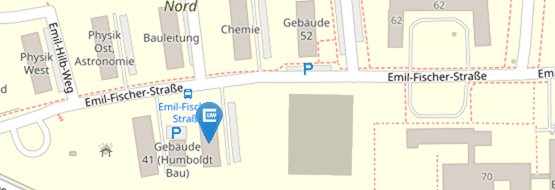
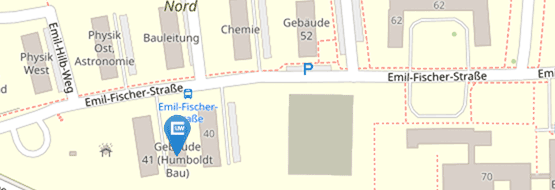
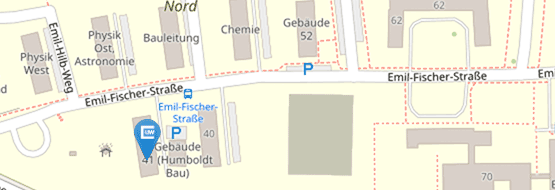
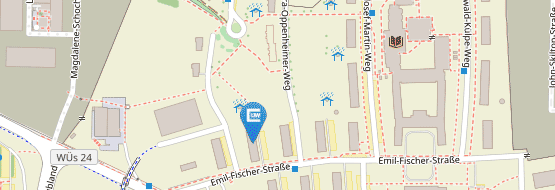
| Ort: | Hubland Nord, Geb. 41, 41.00.006 |
| Veranstalter: | Lehrstuhl für Mathematik IX (Wissenschaftliches Rechnen) |
| Vortragende: | Dr. Andreas A. Buchheit |
Abstract:
I first present the Singular Euler-Maclaurin expansion, an extension of the 300-year-old classical Euler-Maclaurin summation formula to long-range interactions on high-dimensional lattices. This method allows for the exact representation of a discrete lattice in terms of its continuous analog, with corrections given in terms of generalized zeta functions, including systems with boundaries.
Building on this framework, I subsequently study the numerical solution of unconventional BCS superconductors in 2D and 3D with long-range interactions, unconvering both long-range induced topological phases and qualitative changes to the non-equilibrium behavior.
In the second part of the talk, I present how the combination of singular integral operators and generalized zeta functions can allow for the precise evaluation of n-body interaction energies in chemistry given by (n-1)d-dimensional lattice sums, reducing the scaling from exponential to linear in the number of interaction partners n, with direct applications in the study of stability of crystal lattices.
In the simulation of quantum lattices, graph decomposition methods (pCUT) transform the problem of an exponentially growing Hilbert space dimension into the computation of high-dimensional lattice sums associated with graphs, usually evaluated using Monte Carlo methods. In the final part of the talk, I present ongoing work on computing the arising graph zeta functions efficiently and precisely, recovering state-of-the-art Monte Carlo results for the 2D Ising model with longrange interactions within minutes on a standard laptop.