Gemeinsames Oberseminar Wissenschaftliches Rechnen und Mathematik des Maschinellen Lernens und Angewandte Analysis (Emanuel Pfarr)
Stochastic Sampling for Generative Diffusion Models: From Euler-Maruyama to Higher-Order Schemes
| Datum: | 02.12.2026, 14:15 - 15:30 Uhr |
| Kategorie: | Veranstaltung |
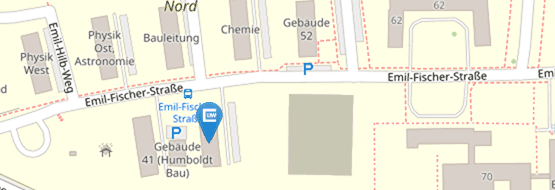
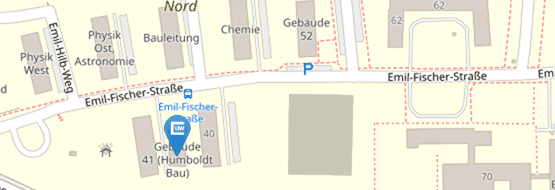
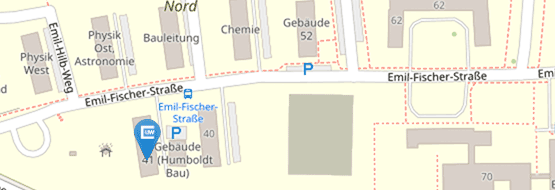
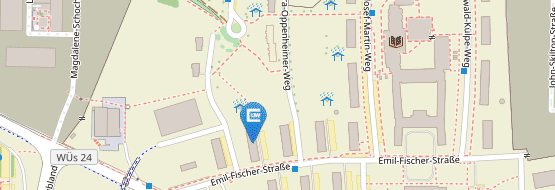
| Ort: | Hubland Nord, Geb. 41, 41.00.006 |
| Veranstalter: | Lehrstuhl für Mathematik IX (Wissenschaftliches Rechnen) |
| Vortragende: | Emanuel Pfarr |

Abstract:
We develop a convergence analysis for generative diffusion models that simultaneously accounts for the three principal error sources in stochastic sampling: initialization, score matching, and discretization of the reverse-time stochastic differential equation (SDE). Our central tool is the notion of a iterative-wise general strong scheme, a broad class of discretization methods for the reverse dynamics defined via explicit, index-wise tolerances on their Itô-Taylor coefficients. This notion refines Kloeden and Platen's general strong schemes into an iterate-wise formulation whose per-step conditions imply the classical remainder bound. We prove a 2-Wasserstein convergence theorem that applies to this entire class, reducing the analysis of any concrete sampler to a finite checklist, and covers general forward processes with time-dependent, spatially linear drift and spatially independent diffusion coefficient. We focus on dissipative reverse-time SDEs, which allows us to relax the T-dependence of the discretization and score-matching errors from exponential to polynomial. We instantiate our theorem for Euler-Maruyama, the exponential integrator, and, as our main application, derivative-free stochastic Runge-Kutta schemes of strong order 1.5. To our knowledge, these are the first full convergence guarantees for solvers whose strong order strictly exceeds that of Euler-Maruyama. We further derive the resulting iteration complexity and a parameter-selection rule for the terminal time, score accuracy, and step size. Numerical experiments on Gaussian toy models and CIFAR-10 are consistent with the predicted convergence orders, and on ImageNet, out-of-the-box higher-order SDE solvers can yield substantial speed-ups, requiring at least four times fewer score evaluations than Euler-Maruyama.