Elena shares important tricks and experiences about the maths teaching degree programme at primary schools
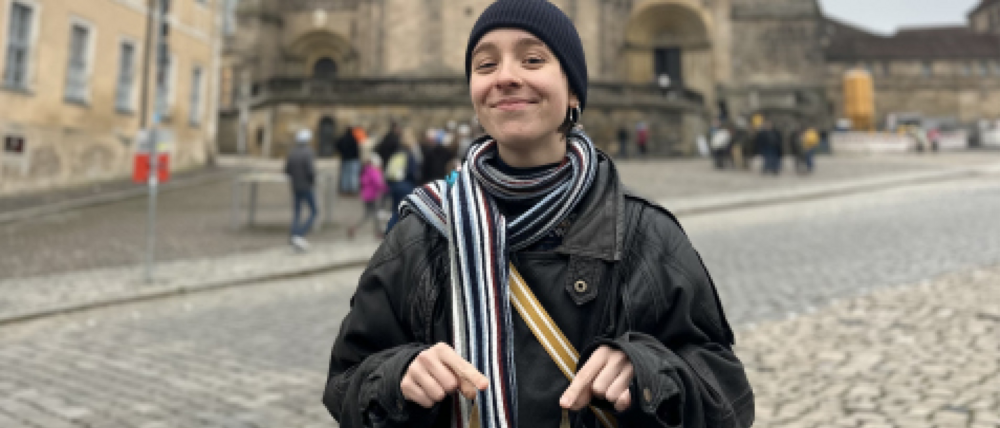
Hi!
I'm Elena, 22 years old and I'm studying to be a primary school teacher with maths as my main subject at the University of Würzburg.
How did I get onto the Primary School Mathematics degree programme?
In the primary school teaching degree programme, you choose a main subject, which then makes up a large part of the degree programme with subject and didactics courses. However, there is also the educational science component: from psychology to educational science and various school internships, as well as primary school didactics, which includes general modules such as literacy acquisition and subject teaching, as well as three chosen didactic subjects. With maths as your main subject, you have to take German, one from art, music or sport and a third subject of your choice. I'm doing English here.
While the pathway and modules are quite rigid in maths, you can often choose between different lectures and seminars in the other subjects and are also quite free in the course of study, so that no two timetables look the same.
That's why creating a timetable can seem like an impenetrable science at the beginning, but don't worry - the university offers advice and help with creating your personal timetable. And it will be easier from the next semesters onwards.
How is the degree programme structured?
In the primary school teaching degree programme, you choose a main subject, which then makes up a large part of the degree programme with subject and didactics courses. However, there is also the educational science component: from psychology to educational science and various school internships, as well as primary school didactics, which includes general modules such as literacy acquisition and subject teaching, as well as three chosen didactic subjects. With maths as your main subject, you have to take German, one from art, music or sport and a third subject of your choice. I'm doing English here.
What can I expect in the maths courses?
Theorems, proofs, collars, matrices, complex numbers and parametrisation - you soon ask yourself why you actually need all of this. After all, you "only" want to become a primary school teacher, where written division is already a supreme discipline. And indeed, the specialised courses do not directly prepare you for teaching at primary school. However, there are didactics modules that you can look forward to;)
Studying maths is a world of its own, which presents many challenges, especially at the beginning. You soon realise that maths is much more than just calculating or applying formulas. Studying mathematics is about recognising structures, abstracting them and proving that certain rules apply at all. This also involves learning a kind of "new language" - with your own symbols, formulations and spellings, as found in scripts and exercises.
I'll be honest: It's exhausting, sometimes frustrating and takes a lot of time. But the moments of success when everything suddenly makes sense or you solve a difficult task are all the more rewarding! For me, studying maths is a constant up and down between frustration and euphoria. Anyone who enjoys puzzling, logical thinking and maths will definitely get their money's worth here.
A few tips for (primary school) maths studies!
First of all, don't worry, you are never alone when studying maths! You will make your first acquaintances in the preliminary course, which will prepare you for the type and language of the lectures without much pressure. So you should definitely take it with you!
From here on, there are the lectures and the exercises - every week there is an exercise sheet to work on and hand in. This is usually done in groups of 2-3 - so make sure you know who you can work with from the start, as it's really important to discuss the material and help each other. I can also recommend that you take the exercise sheets seriously and do as much maths as possible. The more you practise the different types of exercises, the easier they will become at some point.
Also, ask all your questions - to your tutor, lecturer or the JIM explainers. The "Erklärhiwis" are an offer from the university. You can meet them at certain times in the maths practice room and ask them any questions you have about the current material or specific exercises.
But as I said at the beginning - studying maths is only one part of your everyday life as a student. There is so much more to studying to become a primary school teacher and, of course, you shouldn't miss out on your free time;) Würzburg is a beautiful university city and has something to offer for everyone!