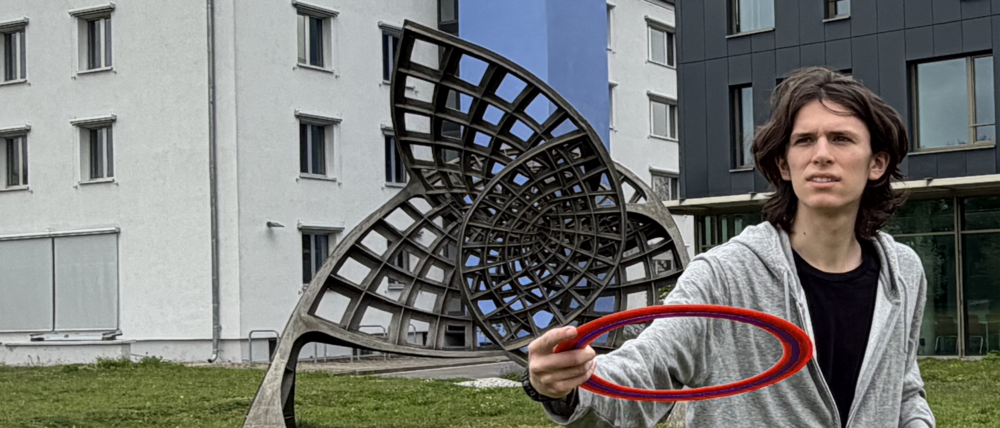
Theo really enjoys the Mathematical Physics degree programme
Do you enjoy physics? Do you sometimes find school maths a bit boring, but do you find in-depth maths cool? Then you're like me two years ago.
Mathematical physics - what do you actually do there?
Firstly, I should perhaps clarify what this actually is. In mathematical physics, you look at problems in theoretical physics from the point of view of mathematics. That's why the Bachelor's degree in Mathematical Physics covers large parts of a maths degree and the theoretical part of a physics degree.
Why is Mathematical Physics just right for me?
As I am very interested in both maths and physics, a degree course that consists of half maths and half physics is just right for me. In addition, there is a wide range of compulsory electives that cover almost all subjects from maths and physics, inviting you to perhaps even study a semester longer.
The solid mathematical training also gives you a deeper understanding of the mathematical concepts used in theoretical physics, which helps you to apply them correctly. On the other hand, the calculation skills acquired in physics help in maths lectures, so the two subjects support each other well.
And as if that wasn't convincing enough, we students of mathematical physics have the friendly nickname "MaPhyns".
How did I start my degree programme?

I actually started studying physics in Würzburg after leaving school. However, I very quickly realised that I was also interested in pure mathematics, which is why I switched to mathematical physics in the second week of my degree.
From this change, I had a lot to do, as in my degree programme you first have to learn the basics of both physics and mathematics in the first semester. However, I really liked this because I learnt a lot of interesting new things in the first semester. Because I enjoyed my degree programme, I actually perceived the heavy workload more as "round-the-clock entertainment". However, I was glad that I hadn't taken on so many projects and commitments alongside my studies in the first semester. There wasn't much time for that.
I also felt very comfortable in an environment of fellow students who all enjoyed maths and physics as much as I did. To cope with the workload, it also helped to work together a lot. You don't need to be afraid of sitting alone in a lecture, as in the first semesters you study together with the physics and maths students anyway.
What I would like to recommend to you when starting your studies is to attend the maths and physics pre-course. The purpose of these preliminary courses is to make the start of your studies a little easier to digest, and they are really important for you to be able to follow your lectures and exercises in the first few weeks. These are not revision courses, so ideally you will have already refreshed your maths and physics knowledge from school.
And afterwards?
After the first two semesters, the workload eases off again. In addition, I can now feel the synergy effects between maths and physics lectures.
After the Bachelor's degree in Mathematical Physics, you have the option of going into maths or physics. The training provided by our degree programme is also appreciated in the private sector. I decided to do the consecutive Master's degree in Mathematical Physics because I really feel at home in my subject.