Julian reports on his Economathematics degree programme
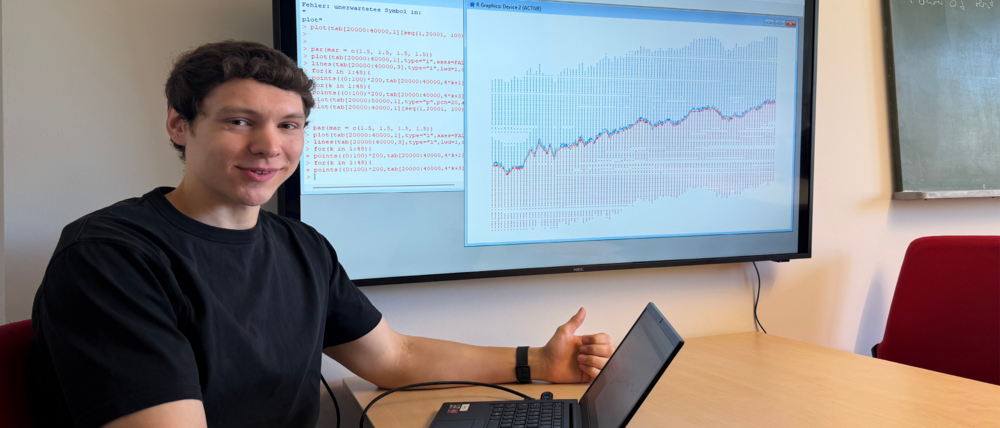
Hey, I'm Julian.
I'm studying Economathematics in my third semester at the University of Würzburg. In this student blog, I would like to give you an insight into my degree programme and share my experiences.
My path to studying business mathematics
My path to this degree programme took a few detours. Fresh out of school, my goal was actually to become a school teacher for Mathematics and English. I started my degree in exactly this combination at the University of Würzburg, but quickly realised that I wasn't suited to it. I dropped out after one semester.
But at that point I already knew that I wanted to study something with mathematics. I enjoyed mathematics by far the most during my old degree programme and so I looked for an alternative degree programme with a focus on mathematics in Würzburg. The pure mathematics Bachelor's programme was too theoretical for me - I wanted applications. As I gained my Abitur at a FOS with a focus on economics and had been interested in economic topics since my school days, my decision was quickly made when I stumbled across the Economathematics degree programme. It combined exactly what I was looking for, especially a small computer science component.
What can you expect in the first semesters?

Preliminary courses in maths and computer science take place before the first lectures begin. The maths pre-course is compulsory, the computer science pre-course optional. I can say straight away that I didn't take part in the computer science pre-course as I didn't see the point at the time - you don't have the first computer science modules until the third semester. In my opinion, however, the maths pre-course is indispensable, as it teaches you essential proof techniques and fundamentals that are already assumed in the first lectures.
The first and second semesters are all about the basics of maths and economics. In mathematics, the focus is on linear algebra 1 and 2 and analysis 1 and 2, on which the following modules in the degree programme build. Economics is all about macroeconomic basics (supply & demand, growth & government), microeconomic basics (consumer theory, producer theory) and the basics of business administration.
What should not be underestimated in this degree programme is the time and work you have to invest every week. It takes a lot of time to complete the weekly exercise sheets in maths and economics. And it's important that you always stay on the ball! Because what I particularly noticed is that everything builds on each other! But it is all the more rewarding when you realise that you are getting better and better at understanding complex relationships in mathematics and multi-layered mechanisms in economics. In this way, you build up lasting knowledge, which is always required during your studies.
And what happens next?
After the first two semesters, the mathematical part concentrates on stochastics and stochastic financial mathematics, and the economics part continues to focus on economics, business administration and risk management. Computer science modules are now also included. There is also a compulsory internship in the 5th semester. But some of this is still up in the air for me.
What I particularly like is that you can organise your studies individually according to your own interests, as you can take a wide range of mandatory elective modules in mathematics and economics. You can steer exactly in the direction you want to go, set individual priorities and specialise, so to speak.