Ronja is studying to become a maths teacher at German Realschule
Hi,
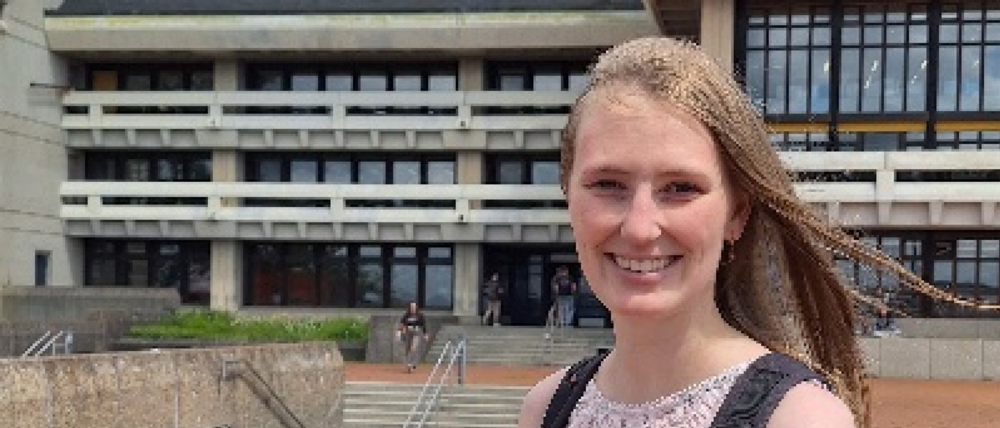
I'm Ronja, I'm 24 years old and I completed my teaching degree for German Realschule in Würzburg in March 2025. My subjects are maths and protestant theology.
Why did I study to become a school teacher?
That's a good question. I knew relatively soon, towards the end of my time at school, that I wanted to be a teacher one day. I've always enjoyed going to school. I was also good - not in all subjects, of course. And I enjoyed helping my classmates, especially in maths, when they didn't understand the material. Over the years, I've also given private tuition and I think I'm quite good at explaining things. During my time at the FOS, I was in the social branch, and then I thought about studying to become a special education teacher. That's how I came to Würzburg. In the end, I was considering a teaching degree for German Realschule with maths and biology. But you can't study this combination in Bavaria. To be honest, I ended up working my way through the list of possible maths combinations by process of elimination - and finally ended up with religion. Because one thing was always clear to me: if I became a teacher, I wanted to teach maths.
How did I get to JMU?
Because of the different school systems, I wanted to study in my home state of Bavaria right from the start. In Bavaria, you can only study to become a school teacher for pupils with special educational needs in Würzburg and Munich. That's why I wanted to have a look at the university in Würzburg. Thanks to the wonderful offer of tandem days and studylive, I was able to accompany students from different degree programmes for a day in their everyday university life.
I really liked the university and the city of Würzburg at the time. In addition, I couldn't do a similar programme at any other university because there wasn't one. So I couldn't see and experience any other university as well as Würzburg. And that's why I went to Würzburg.
Würzburg as a place to study
Würzburg is a green city with a lot of history and many young people. The fact that it is a campus city (the university buildings are spread across the entire city) means that students studying to become teachers in particular have a lot of travelling to do. There is usually half an hour between two lectures - because of the academic quarter before and after the lectures. This half hour can be a bit tight to get from one lecture venue to the next. However, the bus connections are quite good and the bus ticket is included in the semester fee, which is why we students are automatically provided with tickets for public transport in and around Würzburg.
The start of my studies
I started at JMU in October 2020. Finding a flat wasn't that easy, but in the end I was successful and thanks to corona I spent all my time in this flat. It took until the third semester for me to make contact with other students and finally get to know my fellow students.
There was a buddy programme that I had signed up for, which was supposed to make it easier for us to start studying. But you were very much on your own. It was difficult to create your own timetable, find suitable courses and find your way around the many university platforms.
But even if it is normal to feel a little overwhelmed at the beginning, you will be well received in Würzburg. Our student service can help you organise your timetable. You can also get daily help from the Student Advisory Service telephone service or arrange personal counselling appointments.
There is also a wide-ranging first-year programme. This largely depends on the subjects you choose, as many things are organised by the student unions of the different subjects. I helped with the Fresher's Programme in the mathematics and computer science student union. The "first week" for first-year students is usually before the official start of the semester. It's a full week, but a great opportunity to get to know new people and familiarise yourself with the university. A preliminary course is offered in some subjects (highly recommended) and is even compulsory in others. The preliminary course is designed to make it easier for you to start your studies. There are also lots of activities to get to know each other, from city rallies and games evenings to barbecues and pub crawls. I've also had the honour of leading a few campus tours. This involves showing you around the university grounds at Hubland. We help the first-year students to validate their student ID, load money onto it and go to the dining hall together for the first time. I really enjoyed introducing new students to our university and the campus and helping them with everything we had to figure out on our own (due to corona).
About my subjects: Mathematics & Protestant theology
In maths, as in most natural sciences, it is usual to have an accompanying exercise to the lectures. This is where the theoretical content from the lecture is deepened in practice. In addition, there is usually an exercise sheet for a period of one week, which is the equivalent of homework. Usually you work on these in small groups. There is usually a written exam at the end of the semester. You are allowed to write your own formulae for this - a kind of personal cheat sheet on which you can write everything.
Things are very different in protestant religion. There are lectures or seminars but no exercises and tutorials. At the end of the semester, you usually finish with a term paper, which you write over the semester break.
I loved the variety of my subjects and enjoyed dealing with such different working methods and content. However, it is rather typical to stay in one "category". For example, most combine two natural sciences or humanities and languages.
Incidentally, attendance is not compulsory in most courses - you decide for yourself whether you want to come. I thought this freedom was great, even though I was almost always there anyway. It's usually worth it simply because you understand the content much better through the lecture and it's really no fun to work through everything on your own later.
What characterises the teacher training programme?
The teaching degree programme for German Realschule offers a wide range of subjects that can be combined with each other. However, you (unfortunately) cannot combine everything as you wish. Find out more about the structure of the degree programme and the possible subject combinations here: https://www.uni-wuerzburg.de/studium/angebot/abschluss/stex/la-rs/. At JMU, in most subjects lectures are offered that are specific to the teaching profession. You study your subjects "not in depth" and only attend lectures for teaching degree students.
For each subject, you take subject-specific courses and courses in the respective didactics. In addition, you attend seven courses from the educational science fields of psychology, school pedagogy and general pedagogy. There are also some compulsory internships, even if they are not enough in my opinion..If you want even more variety, you can always take up a third or extension subject. Here you are completely free to choose.
The standard period of study is seven semesters. Instead of a Bachelor's thesis, we write an admission thesis (Zulassungsarbeit, Zula). You can choose between your subjects and educational sciences, and you can also select the supervisor. After writing the ZuLa and completing a few courses, you can apply for a Bachelor's degree in teaching. This entitles you to study a Master's degree programme and differs in title depending on the subject in which you have written the ZuLa.
In Bavaria, you complete a teacher degree programme with the state examination. You can then expect two subject-specific examinations and a didactics examination for each subject, which are usually all written (but there are exceptions). There is also a state examination in educational sciences (EWS). Here you can choose whether you want to take the state examination in education, school education or psychology. The EWS state exam is the only one that can be written separately from the other six state exams. Many people therefore do the EWS exam one or two semesters earlier to avoid having to write all seven exams in the same semester. I also did this and would recommend it. If you choose a third subject, you can write the associated three state exams separately from the other six subject-specific exams.
What does a normal university day look like?
Most lectures conveniently do not start before 10 am. This gives you enough time in the morning to start the day in peace, get an overview of the lecture notes or check whether you have completed the compulsory preparation. It's always worth downloading or printing out the lecturer's slides before the lecture - it's a much more relaxed and focused way of taking notes.
As a rule, you have about two to three courses per day: a mixture of lectures, exercises or seminars. In lectures, you usually sit in, listen and ideally take notes. Sometimes it all happens so quickly that you're glad at the end if you've managed to write everything down by the end. The seminars are usually more interactive. The lecturers often ask you to participate. And then there are exercises, where you are usually challenged to work independently most of the time. And yes, sometimes there's a day when there's only one course in the timetable - or it's even completely free. You shouldn't pack your timetable too full, because you definitely need time to prepare, do follow up work or homework.
This can be particularly demanding in maths - you should plan around five hours for one exercise sheet. However, you usually meet up with your study group directly at the university. Personally, I like to look at the exercises on my own beforehand: That way, you can compare whether you've arrived at the same results later on and continue right away where you're still stuck. This saves time and you can see in advance what you can already do.
A real classic: lunch in the Mensa - preferably with friends almost every day. But preferably not at 12 o'clock, when it's at its busiest.
In addition to studying, there is also time for other things: the university sports programme offers many courses - perfect for working out in the evening or simply clearing your head. On sunny afternoons, you can meet up with fellow students on campus or in the neighbouring grounds of the former state garden show at Hubland. It's a great place to relax, lie in the sun or just chat.
Most exams are written in the last week of lectures - and in the two to three weeks after that. Many people prepare in the university libraries in the weeks beforehand. But beware, it gets so full quickly that you often can't find a place at half past nine.
And what about the semester break? They are rarely quite as free as you might imagine. There's often a term paper to write. My personal rhythm: concentrated writing in the library in the morning, dining hall at lunchtime - and then free time. This mixture of productivity and relaxation has always worked well for me.
What was my highlight?
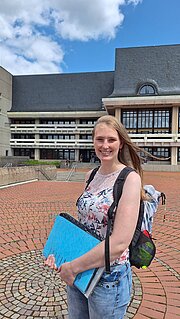
Phew..., I enjoyed my studies and I don't think I can decide in favour of one thing. I love the freedom that comes with studying, the personal responsibility and the independence. You do need a certain amount of self-discipline and the ability to structure yourself. But I've always enjoyed it a lot.
I also really liked the variety and the fact that the teacher training programme is so diverse. With maths, religion, EWS and the internships, there was always enough variety so that you never get too much of one thing.
At this point, I would like to tell you about a situation from a school internship: I was sitting at the back of the classroom in a maths lesson and observing. The bell rang, the lesson was over and the pupils were packing up to move on to the next subject. I heard snatches of conversation about the upcoming lesson - maybe German, history, social studies or English, I can't remember exactly. But at that moment, I realised how glad I was that I didn't have to go. I didn't have to take a subject that I hadn't enjoyed much in my own school days. Instead, I had my favourite subjects all day. I realised that from now on I would only study the subjects that I had chosen myself and that I really enjoyed. Of course, there are also courses on the degree programme that you don't enjoy as much or that require more effort - but you have a choice. And you can change your mind at any time. I can now concentrate on the subjects that interest and inspire me. And later, as a teacher, I will only teach the subjects I enjoy the most all day - what a privilege!
I also became a teaching assistant (HiWi) at the JMU for maths didactics. I worked at the university for a total of four semesters. I accompanied various lectures. I corrected exercise sheets, held tutorials, supervised exams and much more. I always enjoyed the job, it's super flexible and well suited to being done alongside my studies. It also allowed me to consolidate what I had learnt during my studies and gain teaching experience in the university context. I enjoy accompanying students and supporting them with my knowledge and experience.
However, if I had to make a decision, I would probably choose my year abroad as the highlight. I spent an academic year (nine months) studying in Swansea, Wales. That was one of my best decisions ever. I actually enjoyed everything there and used the time to make lots of new experiences and acquaintances. Especially in the teaching degree programme, we have a lot of very specific courses that are tailored to our school system. It is therefore difficult to have courses from abroad recognised. Nevertheless, I can highly recommend it to everyone.
What should you bring with you?
- Self-discipline
- The ability to organise yourself
- Independence
- Enjoy working with people, especially children and teenagers
- Patience
- You should enjoy explaining and communicating
- A certain assertiveness
- Openness to approach people
- Interest and expertise in the subjects of your choice
- Stamina
Tips and tricks
- If you have any questions, go to see the lecturers, for example during their office hours, most of them are very nice and supportive and can certainly help you.
- Take up offers such as "homework time", where someone from the university is on site to help you if you have any questions. In maths we have "Erkärhiwis" who are happy to help you and explain the content of the lecture again and help you with your homework.
- Are you having problems with something or have questions about the lecture material, but don't dare to ask? - You can be sure that the others feel exactly the same way. It only takes one person to have the courage to ask and everyone will be grateful.
- Don't be discouraged if you are completely overwhelmed by the material or suddenly don't understand anything. You need to take a break and persevere. After sleeping on it twice, an idea usually comes up after all.
- And a little warning: the degree programme is very theoretical and not very practice-oriented. You have to accept that you often don't see the connection to school or deal with contents that go deeper into the subject matter than what we will teach at school. Unfortunately, I can only say that this is just the way it is and hope that the practical matters are dealt with in the Refendariat.
- Network with your fellow students, it is very useful to have at least one person per course with whom you can talk, exchange questions and go to lectures together. You can then support each other with your homework, exchange summaries or get notes if you are unable to attend a lecture.
- There is more help available at the university than you might think - use it, it's free. There are counselling services for everything, the Career Centre offers great courses where you can acquire extra skills and tools for your professional life. There is psychological counselling, legal advice and certainly so much more that even I don't know about. The offers are varied and often barely used because many people don't even know about them. You can also go to the Mainfrankentheater for free, for example.
- Subscribe to MoMa or follow the university, your student union etc. to stay informed about what's going on.
- It's better to take a little more time, hardly anyone studies in the standard period of study and you don't really get anything out of it. It's better to only take on so much per semester that you can manage the workload well and have a great time studying for the most part.
- Don't buy all the books that might be on the lecturer's reading list. Many are intended for in-depth study and (almost) everything is available to borrow from the university library as e-books or you can scan the pages. And don't worry, don't be overwhelmed by the size of some of these lists, I usually haven't read any of them.
- Take care of your internships in good time. The registration period is sometimes six or nine months in advance and it's easier to cancel than to register later.
- Choose your seat in the lecture hall or seminar room carefully. It is worth arriving a little earlier, especially at the beginning. Do you need a power socket? Where can you see well from? I would never sit at the back of the lecture hall, you can't see very well and sometimes the lecturer speaks so quietly that you can't understand him or her.
Outlook
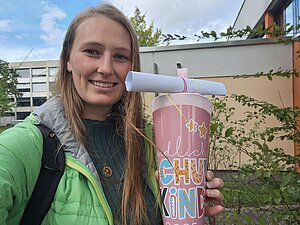
With the completion of my degree, an incredible period of my life lies behind me that I would definitely not want to miss. Sometimes I can't even believe that it's all over now. But I'm looking forward to the next stage of my life, which will now be largely characterised by my traineeship (Referendariat). I'm excited about which school I'll be working, and I'm looking forward to actually teaching and finally learning some practical skills. Nevertheless, I know that this time will be incredibly stressful and I'm a little afraid that the traineeship will be as terrible as many people claim. That the anticipation will fade too quickly and that the traineeship will be more of a torture than a challenge in which you grow. But I don't want to let it take away my anticipation and the hope that it can be a good time despite everything. That's why I'm holding on to it and hoping for the best.